


A groundbreaking new machine developed by Nobel Prize-winning chemist Omar Yaghi can reportedly pull up to 1,000 liters of clean drinking water directly from the air using only sunlight or low-grade thermal energy.
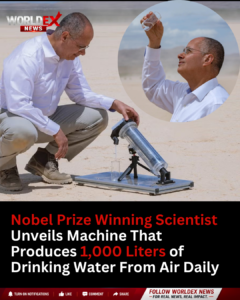
Professor Omar Yaghi, a Nobel Prize-winning chemist at the University of California, Berkeley, has developed a machine capable of producing up to 1,000 liters of clean drinking water per day directly from the atmosphere. The technology is being developed through his company, Atoco.
The system uses advanced materials known as Metal-Organic Frameworks (MOFs) — ultra-porous structures that can capture water molecules from the air even in very dry environments with humidity levels below 20%. Once the moisture is trapped, sunlight or low-grade thermal energy releases the water, which is then condensed into drinkable water.
Unlike traditional atmospheric water generators that require significant electricity for cooling and condensation, Yaghi’s device operates off-grid and is powered by naturally available heat sources, making it potentially useful in deserts, disaster zones, and remote communities facing water shortages.
Researchers say the technology could help address growing global water scarcity, with the United Nations estimating that billions of people experience water shortages each year. The machine has already attracted attention as a possible solution for drought-prone regions and areas where water infrastructure is limited or damaged.
However, some engineers and scientists have urged caution, noting that large-scale deployment, efficiency, costs, and long-term performance still need broader real-world testing before the technology can be considered a complete solution to global water shortages.
⚠️ Disclaimer:
The technology has been publicly demonstrated and reported by multiple sources, but large-scale commercial deployment remains in development. Performance may vary depending on environmental conditions, humidity levels, and operational scale.





Leave a Reply